
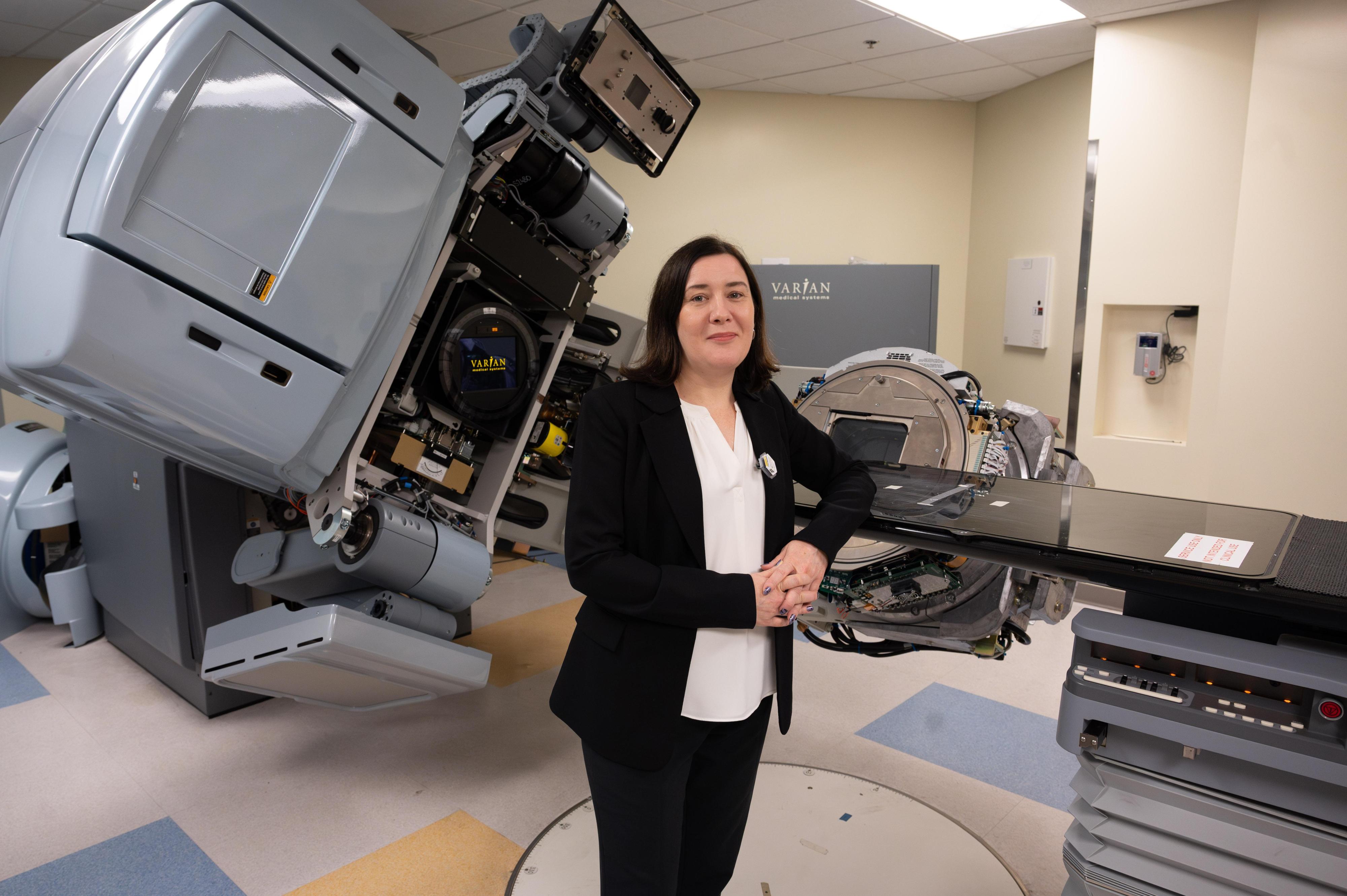
Photo by Joya Chapman
Anna Erickson Wins 2026 Corones Award for Research and Societal Impact
April 9, 2026
By Tracie Troha
Anna Erickson, Woodruff Professor of nuclear and radiological engineering in the George W. Woodruff School of Mechanical Engineering, has been awarded the 2026 James Corones Award in Leadership, Community Building and Communication from the Krell Institute.
The award, named for the Iowa-based nonprofit’s founder, recognizes midcareer scientists and engineers for research impact, mentoring, scientific-community activities, and commitment to communicating science and technology. It will be formally presented to Erickson in May on the Georgia Tech campus.
A committee of Krell Institute collaborators and staff recognized Erickson “for her outstanding accomplishments in research, mentorship, and advancing the public understanding of science and engineering.” The committee also noted that “she has emerged as a leading spokesperson for science and engineering in society…as a translator of fusion research, AI and nuclear power, and nuclear policy and technology,” providing insight for CBS Evening News, NPR Marketplace Tech, BBC News, CNN, and other media outlets.
“Nuclear has a communication problem, not a physics problem,” Erickson said. “If people can’t understand how a system works, they can’t trust it or regulate it. My job is to make complex systems legible without dumbing them down, so policymakers, industry, and the public are making decisions based on reality.”
Erickson leads the Laboratory for Advanced Nonproliferation and Safety, which focuses on bridging a critical gap between the reactor engineering and nuclear nonproliferation communities. Her team integrates theoretical reactor analysis and design with experimental detection.
Beyond her faculty role, Erickson is director of the Consortium for Enabling Technologies and Innovation (ETI), a collaboration of universities and Department of Energy (DOE) national laboratories recognized as a cornerstone of nuclear nonproliferation research. Established in 2019 with $50 million in funding through 2030, ETI engages more than 50 researchers and 100 graduate and undergraduate students across a dozen university partners.
“The real goal of the ETI collaboration isn’t another report or another grant cycle, but rather creating a long-lasting infrastructure,” Erickson said. “We’re building the technical and human systems that make nuclear security measurable, verifiable, and harder to get wrong.”
Krell President Shelly Olsan said Erickson embodies the three pillars that define the Corones Award.
“Her scientific mastery cannot be understated, yet it is her collaborative nature and visionary leadership that I find most striking,” Olsan said. “This was already evident in her time as a Ph.D. student and recipient of the DOE National Nuclear Security Administration Stewardship Science Graduate Fellowship, a program that Jim Corones was instrumental in bringing to fruition.”
Erickson has given talks at universities, national laboratories, and professional societies and conferences worldwide and has contributed to more than 50 peer-reviewed journal publications, including Nature Communications, Physical Review Letters, Scientific Reports and IEEE Transactions on Nuclear Science. She has served on boards and committees of the American Nuclear Society and the IEEE Nuclear and Plasma Sciences Society. She also helps K-12 students in the Atlanta area explore nuclear science concepts through demonstrations, hands-on activities, and laboratory tours.
Erickson earned her Ph.D. and master’s degree in nuclear science and engineering at the Massachusetts Institute of Technology in 2011 and 2008, respectively, and her bachelor’s in nuclear engineering from Oregon State University in 2006.
Founded in 1997 by renowned researcher and administrator James Corones, the Krell Institute develops leaders in science, technology, and national security and communicates their work to broader audiences. The nonprofit corporation manages educational programs that foster collaboration and innovation in computational science, artificial intelligence, and nuclear stockpile stewardship, strengthening connections among science, security, and society.