Georgia Tech Researchers Discover New Mechanism Behind Soft-Material Adhesion
August 11, 2026
By Tracie Troha
Anyone who has peeled off a bandage knows that speed matters. Conventional wisdom, and decades of adhesion research, suggest that pulling faster makes adhesive forces stronger. But researchers at Georgia Tech have discovered that soft materials can behave in a far more surprising way.
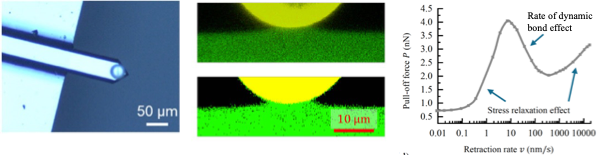
Instead of becoming steadily stickier as they are pulled apart, soft hydrogels first become less adhesive and then more adhesive as the pulling speed increases, revealing a previously unknown "sweet spot" where detachment is easier. The discovery challenges a long-held assumption in adhesion mechanics and reveals a new physical mechanism that governs how soft materials attach and detach.
"We expected the adhesion to increase continuously with pulling speed, as predicted by classical theories," said Yuhang Hu, associate professor in the George W. Woodruff School of Mechanical Engineering and the School of Chemical and Biomolecular Engineering. "Instead, we found the exact opposite over a broad range of speeds. That told us there had to be a completely different physical process at work."
Using high-precision atomic force microscopy, the team measured hydrogel adhesion across four orders of magnitude of pulling speed. Rather than observing the expected behavior, they found that adhesion weakened before strengthening again. To explain the phenomenon, the researchers developed a new theoretical framework showing that two competing molecular processes govern adhesion. While adhesive bonds continuously form while two surfaces remain in contact, those same bonds also relax under mechanical loading. The competition between these two processes creates the unexpected dip in adhesion.
The researchers then used confocal microscopy to directly visualize the contact area between the hydrogel and the surface, confirming the theoretical predictions and providing independent evidence for the newly identified mechanism.
The paper was published in the Proceedings of the National Academy of Sciences.
Although the study focused on hydrogels, the findings extend beyond a single material. Many biological tissues, including cartilage, skin, and the extracellular matrix, as well as emerging soft technologies such as wearable sensors, tissue adhesives, drug-delivery systems, and soft robots, rely on dynamic adhesion. Understanding when adhesion strengthens or weakens could help engineers design interfaces that release more easily, grip more securely, or adapt automatically to changing conditions.
"This changes how we think about adhesion in soft materials," Hu said. "Instead of asking whether pulling faster or slower increases adhesion, we now recognize that adhesion is governed by competing molecular clocks. Once we understand those time scales, we can begin to engineer interfaces with entirely new behaviors."
The discovery provides a new framework for understanding soft-material interfaces and may influence the design of future biomedical devices, bioinspired adhesives, soft robotic grippers, and other technologies in which controlling attachment and detachment is critical.