
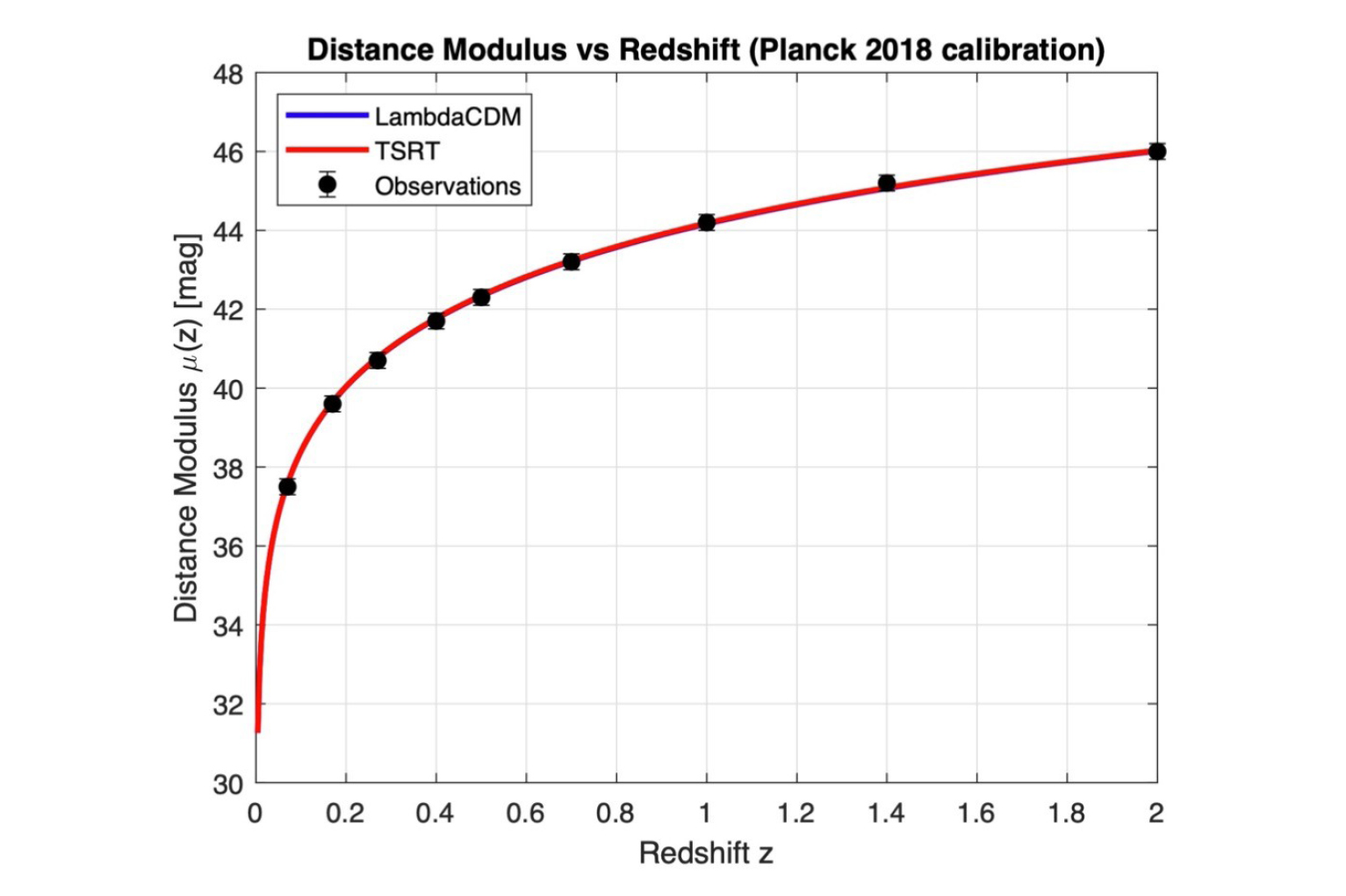
A cosmological result: Distance modulus μ(z) vs. redshift. Observational data (black points), ΛCDM predictions (blue curve), and TSRT predictions (red curve) are shown, all computed using Planck 2018 cosmological parameters (H0 = 67.4 km s−1 Mpc−1, Ωm = 0.315, ΩΛ = 0.685). TSRT performs at least as well as the ΛCDM model and, in addition, it exposes minor oscillatory deviations for z ≳ 1, where future precision data could test TSRT’s predictions.
New Theory Proposes a Unified Way to Understand the Universe — From Atoms to Galaxies
Georgia Tech professor develops geometric framework that connects quantum physics, relativity and nuclear science
December 16, 2025
By Tracie Troha
A Georgia Tech professor has found a way to connect some of the biggest ideas in modern physics and potentially reshape how scientists understand everything from atomic spectra to cosmic expansion.
Nico F. Declercq, a professor in the George W. Woodruff School of Mechanical Engineering, has developed the Trembling Spacetime Relativity Theory (TSRT). The theory proposes that many fundamental physical behaviors — typically explained separately by quantum mechanics, particle physics, general relativity or nuclear models — can instead be explained by a single principle: spacetime itself trembles in microscopic scales.
Since its publication on CERN’s Zenodo platform, Declercq’s work has evolved from a conceptual idea into a unifying framework. The TSRT papers have been downloaded thousands of times and have prompted extensive discussions with physicists in fields ranging from atomic theory to cosmology, illustrating how a single geometric principle can account for wave behavior, particle properties, nuclear stability, and cosmic evolution.
A Geometric Approach to Physics
Traditional physics explains nature using several distinct theories. Quantum mechanics deals with the very small, general relativity with the very large, and particle and nuclear physics cover everything in between. These theories work extremely well, but they don’t always fit together neatly.
TSRT takes a different route. It starts with geometry.
According to the theory, spacetime isn't perfectly smooth; instead, it “trembles” at extremely small scales. Declercq shows mathematically that if this trembling follows rules of causality, many familiar features of physics naturally appear: the shape of Einstein’s spacetime, quantum‐like behavior such as interference, energy quantization, and entanglement correlations, and even limits such as the Planck scale.
The result is a model in which quantum-like behavior — interference, energy levels, and entanglement — arises not from probabilistic wavefunctions, but from deterministic geometric processes.
Revisiting Classic Physics Phenomena
One of the most famous demonstrations of quantum mechanics is the double-slit experiment, where particles create an interference pattern typically associated with waves. TSRT reproduces this pattern without assuming particles behave as waves. Instead, it shows that particles follow deterministic paths that are subtly redirected by local spacetime tremors, creating the same interference effect observed in experiments.
The theory also offers a new view of entanglement. It proposes that entanglement-like correlations arise when particles’ paths remain synchronized through spacetime geometry, offering a mechanism that is both deterministic and consistent with relativity, while still matching quantum predictions.
Applications Across Physics
- Atomic structure: TSRT accurately predicts hydrogen and muonic hydrogen spectra with sub-millielectronvolt precision, using no adjustable parameters beyond a single calibration.
- Cosmology: TSRT provides geometric mechanisms for cosmic expansion, entropy growth, and a naturally small cosmological constant, offering an alternative to inflation-based explanations.
- Nuclear physics: TSRT introduces a geometric model for nuclear structure and reactions, aiming to provide first-principles explanations of stability, fission, and fusion once fully developed.
- Particle Physics: Fundamental particles appear as symmetry-bound trembling modes of spacetime geometry, naturally producing properties like mass, charge, and spin.
Bringing Clarity to Physics Education and Practice
TSRT is more than a theoretical exercise. Declercq envisions it transforming physics education and engineering by replacing paradoxes with clear, geometric reasoning.
Declercq said he anticipates that TSRT “will eventually inform mainstream engineering practice and education by providing a clear geometric alternative where traditional quantum mechanics often leaves students struggling with interpretational paradoxes, freeing them to focus on calculable, physically transparent mechanisms rather than defending the unexplainable.”
Learn More
Declercq’s open-access papers covering double-slit interference, entanglement, atomic structure, particle classification, cosmology, and nuclear physics are available through CERN’s Zenodo repository.
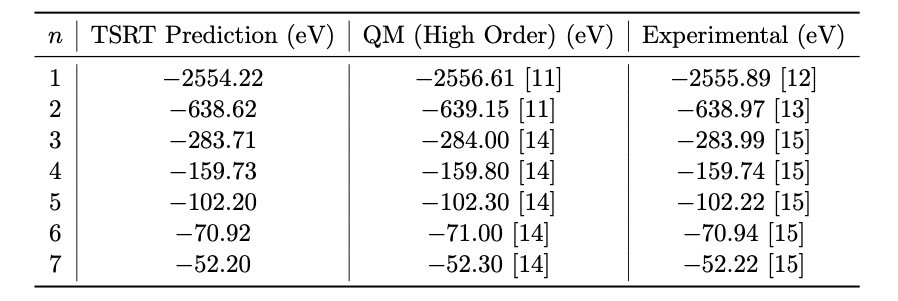
An atomic physics result: TSRT energy level predictions for electrons in Muonic Hydrogen, compared to Quantum Mechanics (QM) and experiments.
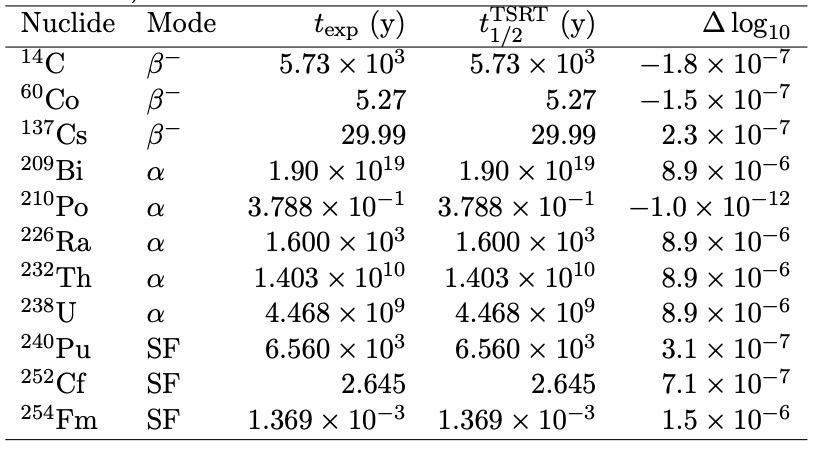
A nuclear physics result: Representative calculated TSRT lifetime benchmarks of different isotopes, compared with experiments.